Cybersecurity Posture Estimation
Cyber Pulse
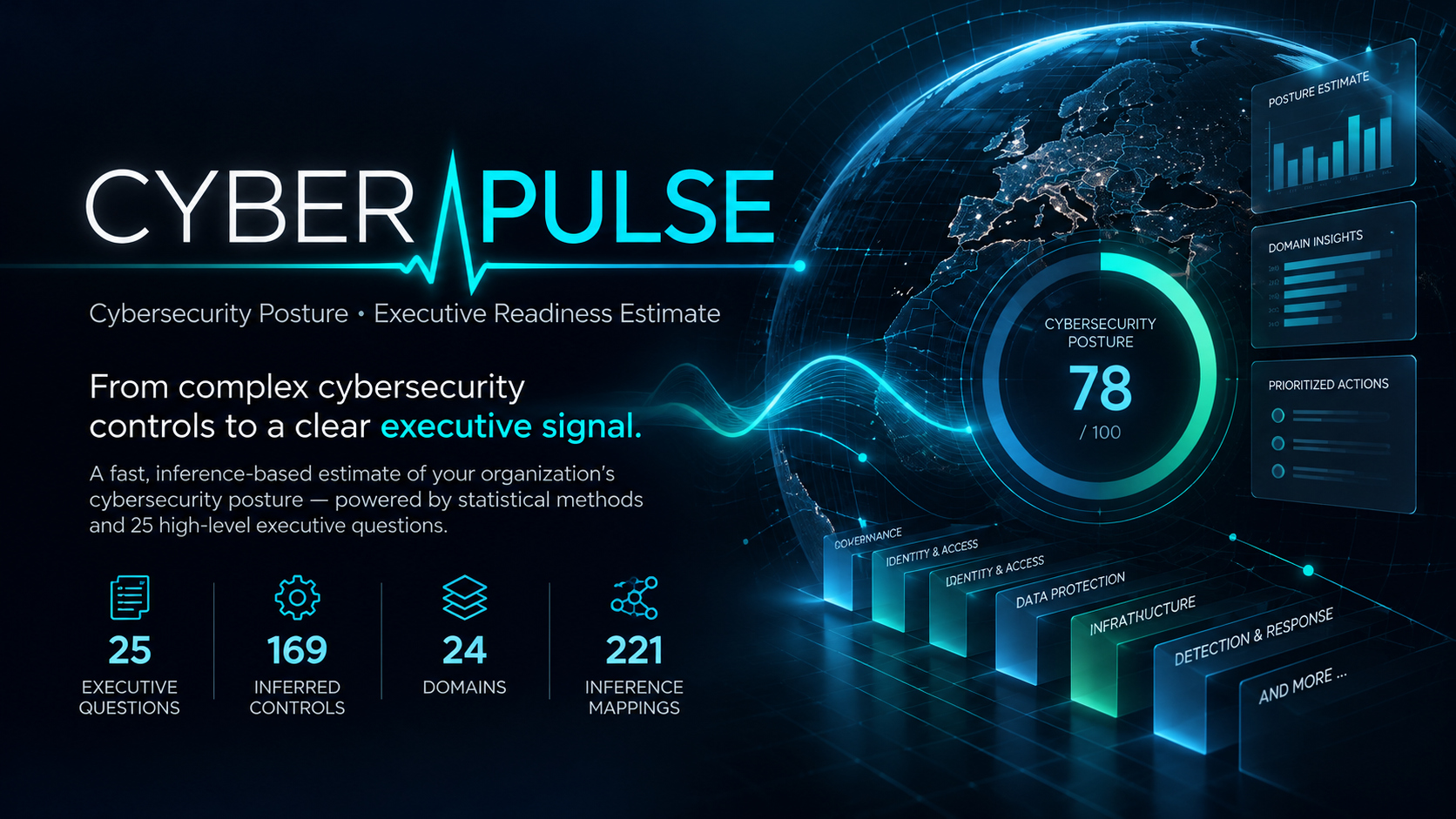
CyberPulse uses 25 high-level questions and statistical inference to provide an initial, directional indication of an organization's cybersecurity posture and highlight areas that may warrant further investigation or improvement.
Indicative estimation tool — not a cybersecurity audit, certification, or substitute for professional assessment.
Background
A faster starting point for executive cybersecurity insight
Cybersecurity assessments can involve extensive control-level questionnaires and significant technical detail. CyberPulse provides a much shorter starting point: 25 high-level questions that can be answered by technology executives without having to work through every technical control individually.
The challenge
Comprehensive cybersecurity self-assessments can encompass well over 100 individual control-level questions. Completing such an assessment requires significant time and technical depth — which can be a barrier at the executive level where a rapid, directional signal may be more actionable than an extended questionnaire.
The approach
CyberPulse is an independently developed analytical application that uses 25 high-level executive questions and statistical inference, including Monte Carlo simulation, to provide an initial indication of an organization's cybersecurity posture. The result is a directional signal, not a substitute for a detailed assessment.
Methodology
How CyberPulse works
CyberPulse estimates cybersecurity posture from 25 high-level questions using a statistical inference model derived from the structure and control areas of an extensive cybersecurity assessment framework associated with the Greek National Cybersecurity Authority (Εθνική Αρχή Κυβερνοασφάλειας). Because the underlying framework is substantially broader than 25 questions, the output is an estimate based on inferred relationships and probabilistic methods.
Step 1
25 executive questions
A focused set of high-level questions designed to be answered by technology executives without requiring a detailed control-by-control questionnaire.
Step 2
Statistical inference
Responses are mapped through an inference model derived from the structure and control areas of a substantially broader cybersecurity assessment framework.
Step 3
Monte Carlo analysis
Weighted mappings, applicability assumptions, and probabilistic/Monte Carlo methods represent uncertainty in the inferred results.
Step 4
Directional insight
The output provides a high-level indication of cybersecurity posture and highlights areas that may deserve further analysis or improvement.
Context
Relationship to the underlying assessment framework
The development of CyberPulse was informed by the structure and control areas of an extensive cybersecurity self-assessment framework made available by the Greek National Cybersecurity Authority (Εθνική Αρχή Κυβερνοασφάλειας). That reference framework encompasses approximately 200 questions covering a broad range of security controls — substantially broader than the 25 executive-level questions used by CyberPulse.
The approach taken in CyberPulse is derived from the structure and control areas of that broader framework. CyberPulse does not reproduce the full assessment; it provides an inference-based estimate from a much smaller set of executive-level questions. The underlying self-assessment framework is publicly available from the Greek National Cybersecurity Authority: Εργαλείο Αυτοαξιολόγησης — Greek National Cybersecurity Authority → (this link leads to the reference assessment resource, not to the CyberPulse application).
Important limitations
Important limitations
CyberPulse is an informational, indicative, and inference-based cybersecurity posture estimation tool. It is designed to provide a high-level indication of an organization's cybersecurity posture and to help identify areas that may warrant further investigation, assessment, or improvement.
CyberPulse does not constitute a cybersecurity audit, risk assessment, compliance assessment, certification, legal opinion, professional advice, or assurance of any kind. Its results must not be treated as definitive, exhaustive, or authoritative representations of an organization's actual cybersecurity posture, risk exposure, regulatory compliance, or security effectiveness.
CyberPulse estimates cybersecurity posture from 25 high-level questions using a statistical inference model derived from the structure and control areas of a substantially broader cybersecurity assessment framework associated with the Greek National Cybersecurity Authority (Εθνική Αρχή Κυβερνοασφάλειας). Because the underlying framework is broader than the 25 questions presented by CyberPulse, the results are necessarily estimates based on inferred relationships between the answers provided and underlying controls. The model uses weighted mappings, applicability assumptions, and probabilistic/Monte Carlo methods to represent uncertainty in that inference.
CyberPulse should be used only as a general directional signal and starting point for further analysis. No user, organization, executive, board, cybersecurity professional, or other decision-maker should rely solely or implicitly on a CyberPulse result to determine cybersecurity strategy, security investments, risk acceptance, remediation priorities, regulatory compliance, incident preparedness, or other material cybersecurity decisions.
Any material cybersecurity decision should be supported by appropriate professional judgment, detailed control-level assessment, organizational context, technical evidence, threat and risk analysis, and, where appropriate, independent cybersecurity, legal, regulatory, or audit advice.
A favorable CyberPulse result does not mean that an organization is secure, free from material vulnerabilities or risks, compliant with applicable laws or regulations, or adequately protected against cyber threats. Conversely, a lower result does not by itself establish that an organization is non-compliant or materially exposed to a specific threat.
CyberPulse does not replace the underlying assessment framework, a detailed control-by-control assessment, a formal risk assessment, penetration testing, vulnerability assessment, security audit, regulatory assessment, or professional cybersecurity advice.
Use of CyberPulse constitutes acknowledgment that its results are estimates intended to provide general direction only and that responsibility for interpreting the results and making any resulting decisions remains entirely with the user and the organization.
CyberPulse is an independently developed analytical application. It is not an official tool, certification, assessment or representation of the Greek National Cybersecurity Authority (Εθνική Αρχή Κυβερνοασφάλειας).
Ready to get a directional cybersecurity posture signal?
Answer 25 high-level executive questions and receive an inference-based indication of your organization's cybersecurity posture.